Built for political decisions
The survey stack is designed for campaign strategy, not just vendor data collection, so findings map directly into targeting, message, and field decisions.
Surveys
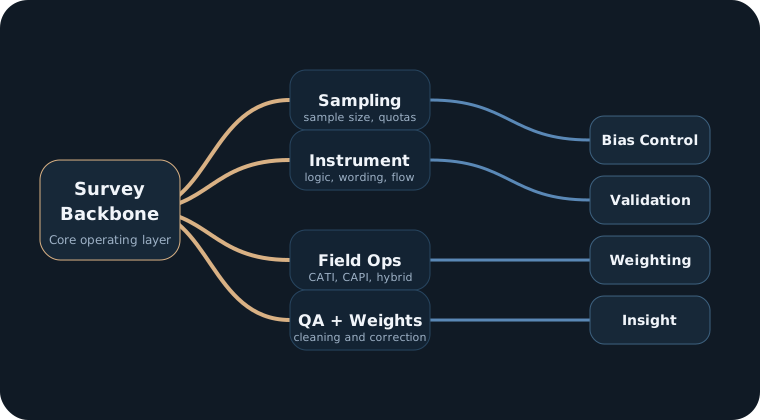
Every serious political consulting recommendation starts with structured data collection. Our survey application is built for political survey research in India across CATI, CAPI, technical, objective, subjective, and mixed-format questionnaires, with sampling, instrument design, field control, QA, and statistical correction working together.
Why This Stack
This system is built for voter intelligence and campaign decisions, not just survey operations in isolation.
The survey stack is designed for campaign strategy, not just vendor data collection, so findings map directly into targeting, message, and field decisions.
CATI, CAPI, technical instruments, QA, weighting, and reporting sit in one workflow so political survey research stays auditable from sample design to topline.
Sampling, instrument design, live monitoring, correction loops, and statistical reporting are managed together so speed does not degrade voter intelligence quality.
Operational Methods
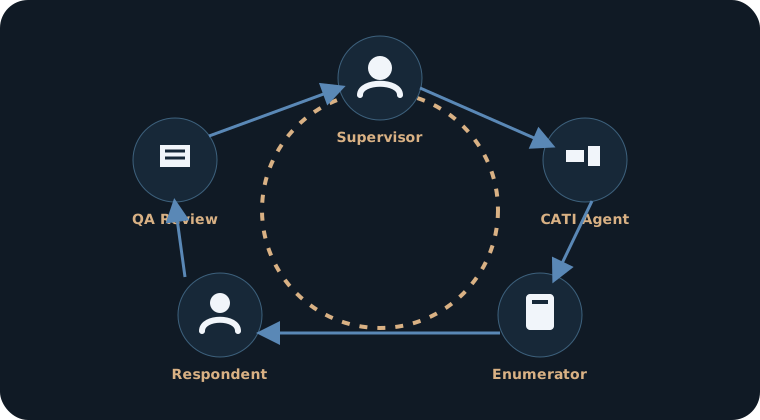
Reliable political survey research is not one-mode by default. We choose CATI, CAPI, CAWI, or hybrid execution based on coverage, respondent behavior, and deadline constraints.
Best for: Fast turnaround, centralized supervision, short trackers
Use when
Strengths
Best for: Higher coverage, better comprehension, longer interviews
Use when
Strengths
Best for: Low-cost scale for digitally reachable audiences
Use when
Strengths
Best for: Representativeness and speed under tight timelines
Use when
Strengths
Statistical Methods
Sampling design, sample-size calculation, margin of error, weighting, trend control, and model-assisted estimation are built into the methodology layer before interpretation starts.
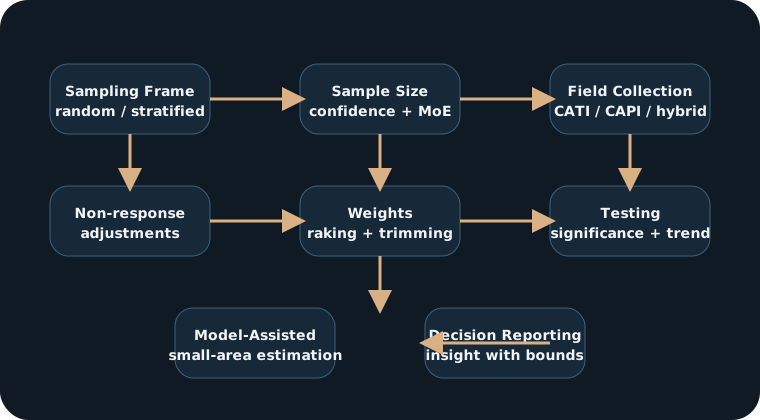
We select simple random, systematic, stratified, cluster, quota, or oversampling frameworks depending on list quality, geography, subgroup importance, and operational constraints.
Sample size is computed against required confidence levels, expected variability, and acceptable error at both headline and subgroup levels so thin cuts are not over-interpreted.
Design weights, non-response adjustments, post-stratification or raking, and weight trimming are used when the achieved sample drifts from the target population.
We use significance testing, trend smoothing, segmentation, and regression or classification logic to separate signal from noise and identify meaningful drivers.
For booth, ward, or other small-area reads, calibrated model-assisted estimation can be used when direct sample size per unit is too small, always with clear uncertainty limits.
Survey Flow Engineering
A survey is a funnel. If the funnel leaks through bad sequencing, skip failures, or fatigue, the sample shifts and the estimate drifts. We treat flow like a product system.
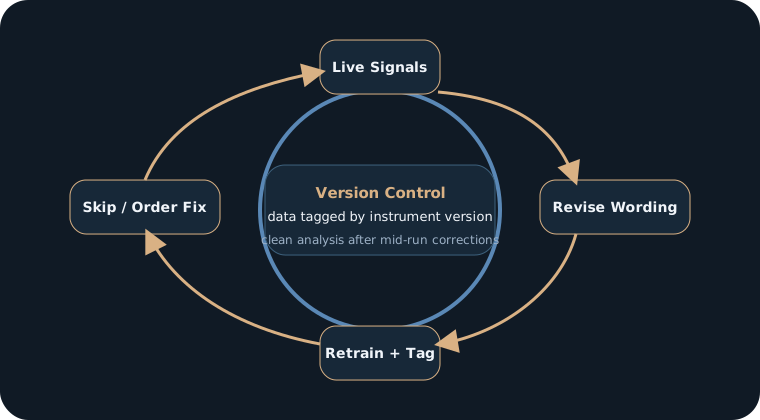
Skip logic is enforced by the tool wherever possible so routing does not depend on agent memory.
Probes are standardized and neutral. They clarify meaning but never push respondents toward an answer.
Prompting is used only for comprehension support, never for persuasion or answer shaping.
Refusal handling is scripted, ethical, and designed around respectful recontact or rescheduling, not pressure.
Quality System
Quality is not a checklist. It is a prevention, detection, and correction system that reduces avoidable error before, during, and after fieldwork.
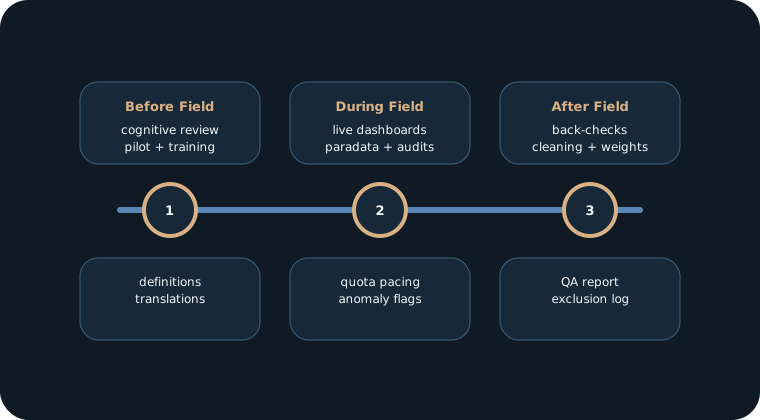
We prevent avoidable errors before launch through cognitive review, pilots, role-play training, clear codebooks, and back-translation checks.
We monitor live dashboards, listen-ins, spot visits, paradata anomalies, quota pace, and audit trails while the survey is running.
We run back-checks, cleaning rules, coding checks, weighting, sensitivity review, and a documented QA report after closure.
Bias Control
We actively reduce interviewer, questionnaire, sampling, routing, coverage, recall, translation, and processing bias through design discipline and audit-led controls.
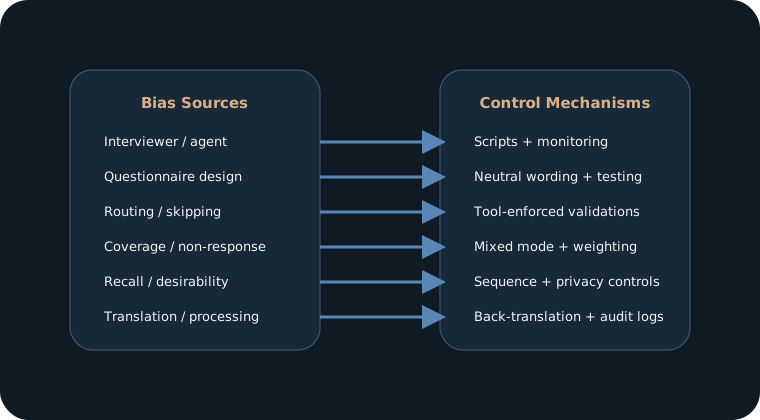
Issue: Tone, paraphrasing, selective probing, or over-helping can reshape the response.
Control: We use tight scripts, standardized probes, monitoring, retraining, audio audits, and performance scorecards.
Issue: Leading, loaded, or double-barrel questions force distorted answers.
Control: We use neutral wording, split questions, balanced options, and cognitive testing.
Issue: Incorrect routing pushes respondents into the wrong sections and corrupts the instrument.
Control: We enforce tool-led skips, validations, mandatory checks, and simplified agent interfaces.
Issue: Unreachable people may systematically differ from reachable respondents.
Control: We use callback schedules, mixed modes, reachability analysis, and non-response weighting.
Issue: A single mode can exclude parts of the target population.
Control: We improve frames, use hybrid modes, and report explicit caveats and corrections.
Issue: Respondents may answer what feels acceptable or remember events incorrectly.
Control: We sequence sensitive items carefully, use shorter recall windows, anchoring, privacy assurances, and self-admin modes where appropriate.
Issue: Question order, language shifts, and inconsistent cleaning choices can distort outcomes.
Control: We use option rotation, back-translation, documented coding rules, dual coding, and reproducible audit-led pipelines.
Deliverables
The output is not just a dataset. We deliver the instrument, operations structure, methodology note, reporting layers, and a documented integrity view that can feed campaign strategy directly.
Leadership summaries, issue rankings, respondent cuts, voter movement patterns, and recommendation briefs built from validated survey data.
Interactive dashboards, trend views, booth or segment breakouts, and deeper analytical outputs that support both war-room reviews and long-form strategy work.
Survey FAQs
These FAQs explain how the survey system supports campaign decisions, methodology control, and voter intelligence quality.
The survey stack is built for campaign decisions, not just raw data collection. Sampling, instrument design, field control, QA, weighting, and reporting are managed inside one system so voter intelligence stays decision-ready.
CATI works for fast centralized trackers, CAPI works when field comprehension and coverage matter, and hybrid research works when a campaign needs both speed and representativeness across different respondent environments.